
Your Testing Framework Isn't Broken. It's Obsolete.
Most testing frameworks were built for a delivery model that no longer exists. Here's what an AI-native testing framework needs to look like instead.
Most testing frameworks were built for a software delivery model that no longer exists. They were designed for monthly releases, stable applications, and QA teams with time to write and maintain scripts. Today's teams deploy continuously - testing hasn't kept up. The result is growing quality debt, fragile automation, and increasing release risk.
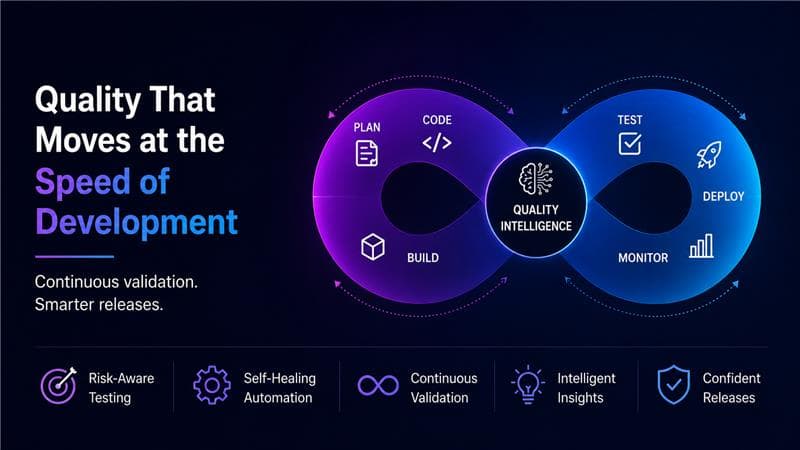
The Problem Isn't a Lack of Tools
Ask engineering leaders about their biggest testing challenge and the answer is rarely "we need another testing tool." It's usually "we can't keep up." The challenge isn't effort - it's that traditional testing frameworks place all decision-making on humans and all execution on scripts. Eventually, both become bottlenecks.
- Test coverage falls behind development
- Automation breaks after every change
- Regression cycles become longer
- Production bugs slip through
Software Delivery Changed. Testing Didn't.
The traditional testing pyramid - unit, integration, end-to-end - isn't broken. The environment around it changed. Modern teams release dozens of times per week, yet many testing processes still rely on manual test design, script-heavy automation, human-led maintenance, and end-of-sprint validation. That's where quality debt begins.
AI-Native Doesn't Mean "AI Features"
Many tools claim to be AI-powered. Most simply add AI capabilities to traditional workflows. AI-native testing is different: instead of requiring humans to decide what to test, create every scenario, maintain every script, and investigate every failure, the framework continuously participates in the quality process itself. It acts less like a tool and more like a Digital QA Teammate.
What Modern Testing Frameworks Need
Four capabilities separate AI-native testing from AI-assisted testing.
- Story-Aware Test Generation - Understand Jira stories, PRDs, and acceptance criteria to automatically generate meaningful test coverage as soon as requirements are written.
- Self-Healing Automation - Detect changes, understand impact, update affected tests, and continue execution without waiting for human intervention. The goal isn't better maintenance - it's less maintenance.
- Continuous Validation - Test every commit, every merge, every deployment - not just nightly runs - reducing feedback loops from days to minutes.
- Intelligent Reporting - Answer "why does it matter?" not just "what failed?" with business impact, risk prioritization, and user journey visibility.
How Nogrunt Approaches It
Nogrunt was built around a simple belief: QA engineers create value through risk assessment, coverage strategy, and quality leadership - not repetitive script creation and maintenance. The goal isn't replacing QA teams. It's amplifying them.
- Reads stories during sprint planning and generates coverage automatically
- Executes continuously and self-heals automation
- Expands coverage as products evolve
The Teams That Win
The teams that win won't be the teams with the most tests. They'll be the teams with intelligent coverage, self-maintaining automation, continuous validation, and AI-native quality processes. Competitive advantage won't come from more testing - it will come from testing systems that learn, adapt, and scale alongside software delivery.