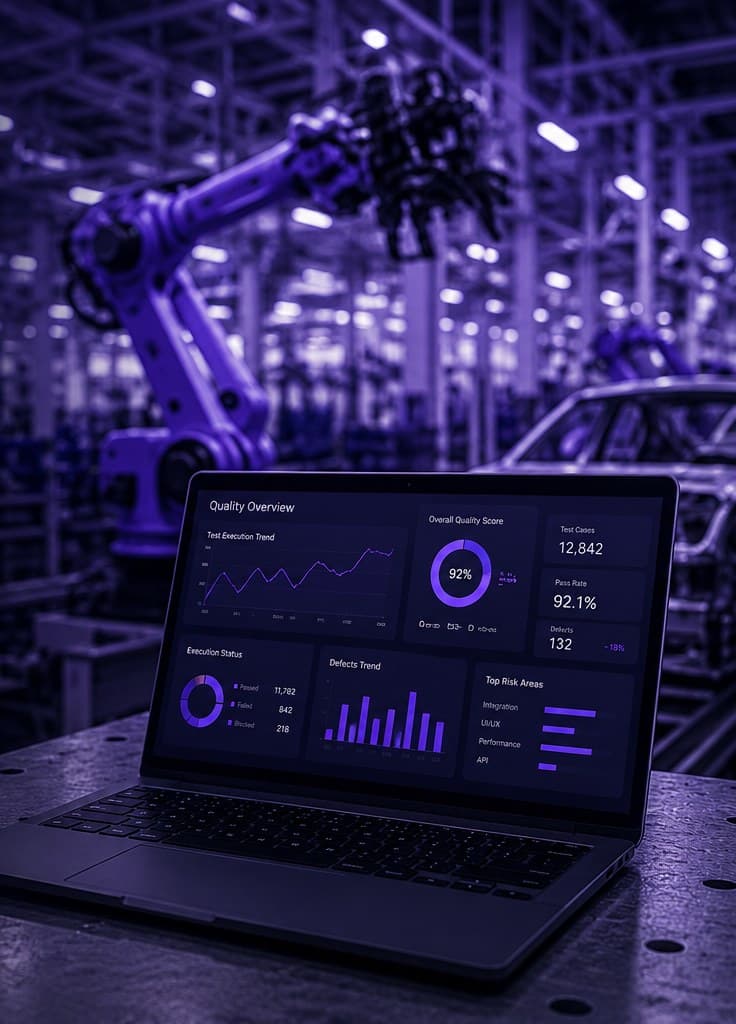
The Hidden Operational Risk in Modern Manufacturing Isn't the Machine. It's Software.
Manufacturing runs on connected software systems, not individual applications. Every software release is now a production event - and quality engineering must evolve accordingly.
Manufacturing has entered a new era where production is orchestrated as much by software as it is by machines. Production schedules are generated in ERP systems. Manufacturing Execution Systems (MES) dispatch work orders to the shop floor. PLCs and SCADA systems execute machine instructions. Warehouse Management Systems synchronize material movements. Quality Management Systems capture inspection records, while Industrial IoT continuously streams equipment and process data. As manufacturers accelerate digital transformation, software is no longer supporting production - it is driving it.
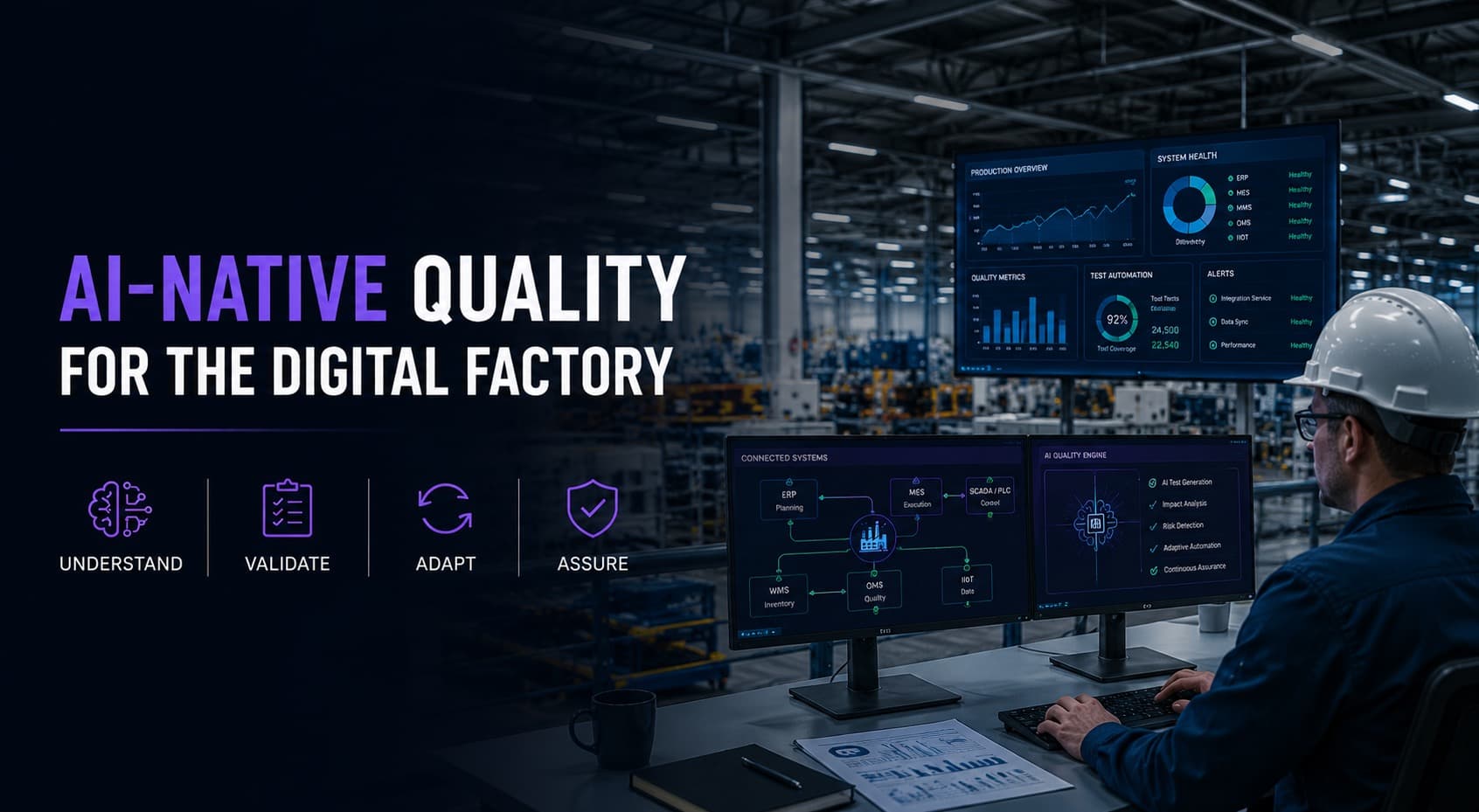
A Software Release Is Now a Production Event
Manufacturing organizations routinely invest in predictive maintenance, equipment reliability, and process optimization to minimize production risk. Yet one of the largest sources of operational disruption often receives far less attention: software change. An update to production scheduling logic can alter finite capacity planning. A configuration change in the MES can disrupt work-order execution. An ERP enhancement may delay material reservations. A modification to an integration service can interrupt production confirmations before they reach downstream planning systems.
None of these failures originate on the shop floor. Yet every one of them can affect throughput, schedule adherence, inventory accuracy, traceability, and ultimately customer delivery. The modern factory is no longer vulnerable only to mechanical failures - it is equally dependent on the reliability of its digital operations.
Manufacturing Runs on Connected Systems, Not Individual Applications
ERP plans production. MES orchestrates execution. SCADA and PLCs control industrial equipment. Warehouse Management Systems coordinate material flow. Quality Management Systems maintain product genealogy and compliance. Industrial IoT platforms provide real-time operational intelligence. These platforms do not operate independently - they execute a single operational value stream where every transaction influences the next. Testing applications individually no longer provides confidence that manufacturing operations will continue uninterrupted after deployment.
The Greatest Risk Is Operational Regression
A seemingly insignificant software change can introduce what may be called operational regression, where production workflows continue to execute but no longer behave exactly as intended. Individually, each system appears operational. Collectively, the manufacturing process begins to lose integrity. These issues rarely surface during isolated functional testing because they emerge across interconnected business processes rather than within a single application.
- Production routing may change unexpectedly
- Material allocations may become inconsistent and batch genealogy incomplete
- Inventory balances may drift and quality records may fail to synchronize
- Production sequencing may no longer reflect planning priorities
Why Traditional Quality Assurance Falls Short
Most Quality Assurance methodologies were designed for enterprise applications where functionality could be validated within defined system boundaries. Manufacturing does not operate within those boundaries. The objective is no longer to determine whether an application passed its test cases - it is to verify that production can continue without interruption after every release. Quality Engineering must evolve from feature validation to operational assurance.
AI Is Reshaping Quality Engineering for the Digital Factory
As manufacturing environments become more connected, the scale and complexity of release validation increase exponentially. Static automation frameworks struggle to keep pace with changing production workflows, evolving business rules, configurable ERP landscapes, and continuous application enhancements. AI can interpret business requirements, understand manufacturing workflows, generate validation assets automatically, continuously evaluate production-critical scenarios, and adapt to application changes through resilient automation - giving greater confidence that every software deployment preserves operational integrity across the manufacturing value stream.
Where Nogrunt.ai Fits
Nogrunt.ai is built for manufacturers operating complex digital production environments where software quality directly influences operational performance. As an AI-native Quality Engineering platform, it continuously validates end-to-end manufacturing workflows across ERP, MES, warehouse systems, enterprise applications, and integrated digital processes. By automatically generating validation assets, executing adaptive regression, and integrating into modern CI/CD pipelines, Nogrunt.ai enables engineering teams to identify operational risk before software reaches production - protecting production continuity, operational resilience, and business performance.