From Test Automation to Quality Intelligence
Why software quality needs to evolve in the age of AI - moving from running more tests to understanding change, impact, risk, and release readiness.
Software development is entering a new phase. AI can generate code, write tests, explain failures, refactor applications, and accelerate development across the SDLC. According to Stack Overflow's 2025 Developer Survey, 84% of developers are already using or planning to use AI tools in their development process. Yet trust has not kept pace: more developers reported distrusting AI output than trusting it.
This creates a new engineering reality: software can now be created faster than teams can confidently validate it. For years, the answer to faster development was test automation. But as development accelerates, simply automating more tests is no longer enough. The next question is not "How many tests can we run?" It is "Do we understand what changed, what could be affected, what matters most, and whether the software is safe to release?" That is the shift from Test Automation to Quality Intelligence.
Automation Solved Speed. The Next Problem Is Understanding.
Test automation transformed QA by replacing repetitive execution with scalable, repeatable testing. But automation largely works from predefined knowledge - it knows what to execute, what result is expected, and whether an assertion passed or failed. Automation tells you what happened. Quality Intelligence helps you understand what it means.
- Run regression suites faster and increase test coverage
- Integrate testing into CI/CD and detect defects earlier
- Reduce repetitive manual effort
- But it can't tell you what changed, what that change affects, or whether a failure is a defect or noise
The Automation Problem Nobody Talks About Enough
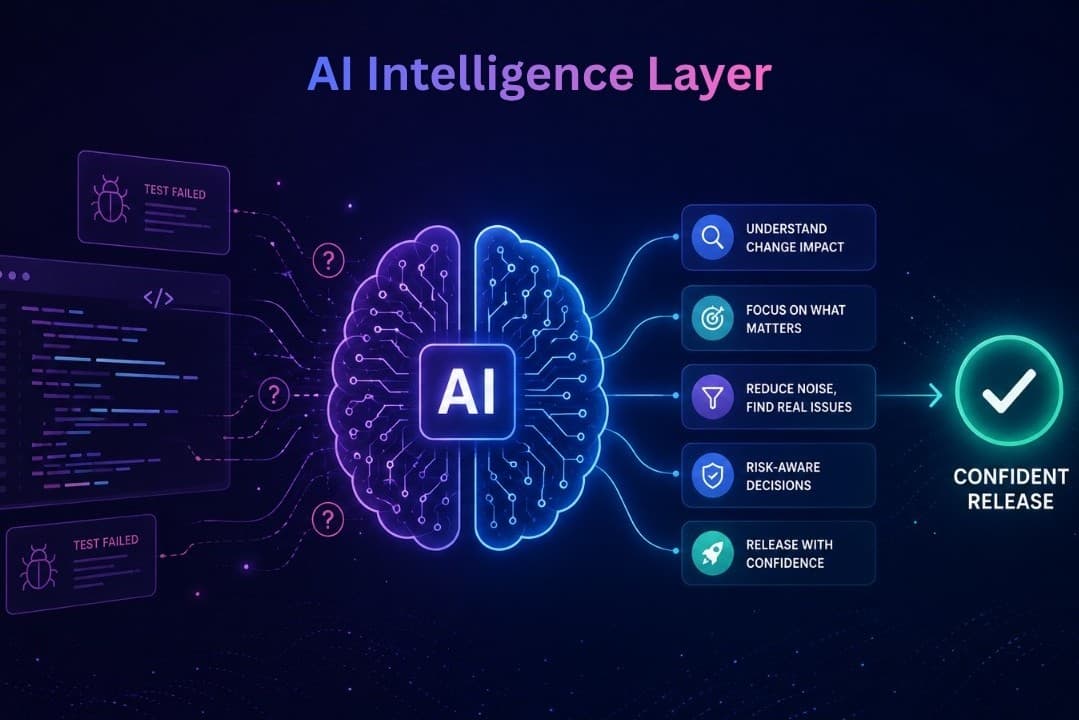
Automation itself can create a new problem at scale: too much information without enough context. Imagine a shared API or UI component changes and 300 automated tests fail. Those failures could represent 300 defects, one underlying application change, a broken test component, an environment issue, or a combination of several factors. The automation has detected the problem, but the engineering team still has to interpret it - and that interpretation is where significant engineering time can disappear.
What Quality Intelligence Actually Means
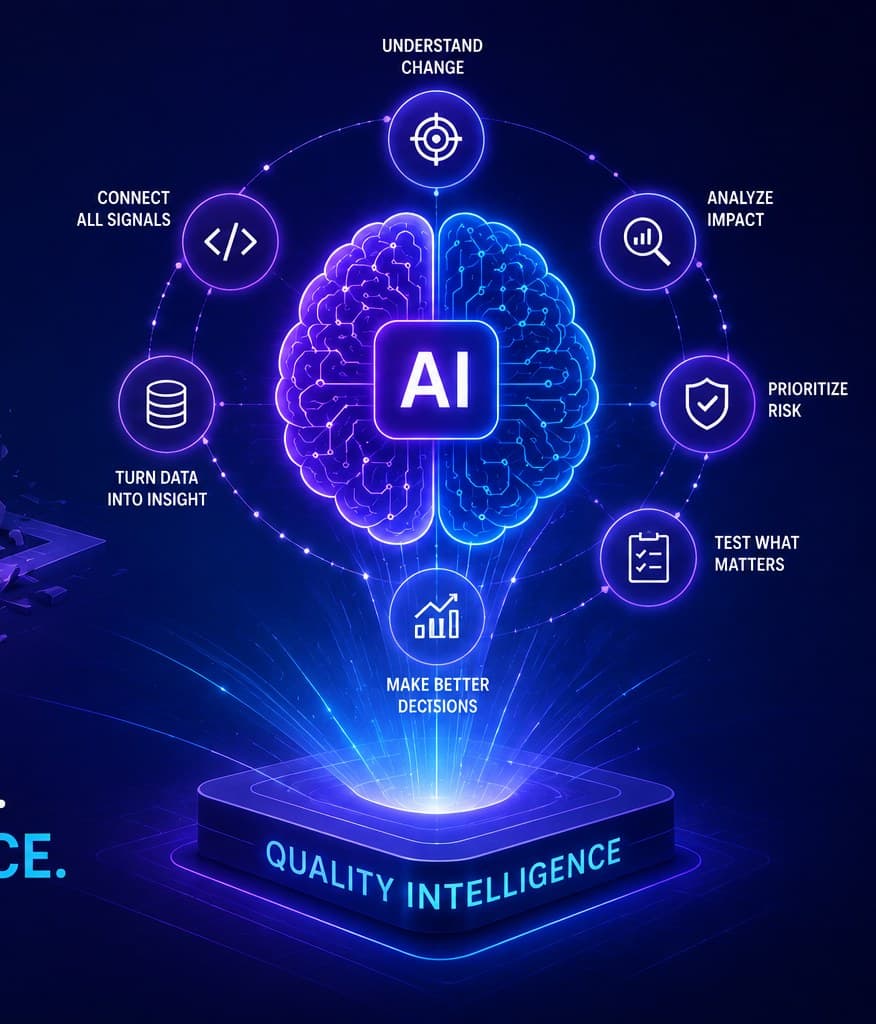
Quality Intelligence is not simply "AI for testing." It is the ability to connect quality signals across the software lifecycle and use context to determine impact, relevance, risk, and priority.
Traditional automation follows: Requirement → Test → Execute → Pass/Fail. Quality Intelligence follows: Requirement → Change → Impact → Risk → Relevant Tests → Results → Analysis → Decision. Instead of treating testing as a collection of scripts, it treats quality as a connected system of evidence - requirements, code changes, APIs, tests, defects, CI/CD, historical results, business criticality, and production signals.
From "More Tests" to "Right Tests"
Traditional thinking says "run the full regression suite." Quality Intelligence asks "what changed, what could be affected, and which tests give us the highest-value signal?" A change to a payment service should not be treated the same way as a change to a low-risk UI component. The goal isn't necessarily to run fewer tests - it is to make testing more risk-aware.
- What code changed and which requirements are connected
- Which services depend on the change and which tests cover those areas
- Historical failures, defect history, business criticality, and test reliability
From Failure Detection to Failure Understanding
A test failure is not automatically a product defect. Quality Intelligence can help move teams from "67 tests failed" to "these 67 failures appear to originate from three related failure patterns, one of which affects a business-critical workflow." AI can assist with failure clustering, pattern recognition, historical comparison, correlation, and root-cause analysis - but the engineer remains accountable for the final decision. AI reduces the time required to reach that decision.
Where Nogrunt Fits
At Nogrunt, we believe the future of software quality is not about replacing automation - it is about making automation understand the software it is testing. The objective is simple: less time maintaining automation, less time investigating noise, more time engineering for quality. Because the real value of an automated test suite isn't the number of tests it can execute - it is the quality of the decisions those tests help an engineering team make.
- AI-assisted test generation and requirement understanding
- Change and impact analysis with intelligent test prioritization
- Failure and pattern analysis with predictive quality insights
- Intelligent reporting across the full development lifecycle